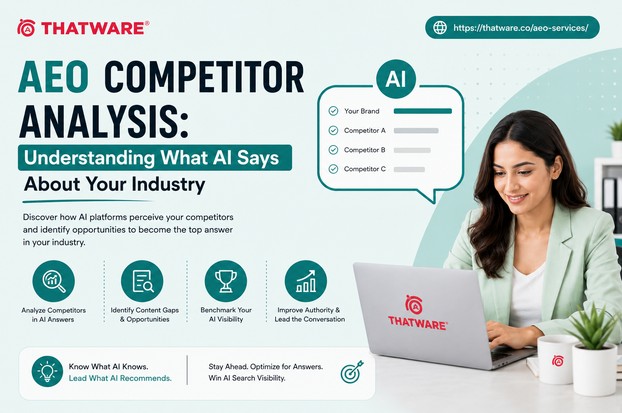
Most competitive intelligence work focuses on what competitors are doing in places you can see — their website, their ads, their social content, their product releases. It’s all visible and trackable. You can monitor their keyword rankings, watch their campaign targeting, benchmark their pricing, and read their reviews.
But there’s an increasingly important competitive dimension that most intelligence programs are missing entirely: what AI systems say about your competitors, and what they say about you. Because if your target buyers are getting their initial picture of your category from AI assistants, the competitive landscape that exists in AI-generated answers may be more consequential than anything happening in traditional channels.
Understanding that landscape — and then working to change it — is what AEO competitor analysis is actually about.
The AI Answer Audit: What to Look For
The starting point is surprisingly simple: systematically ask AI tools the questions your target buyers are asking, and document what you find. Who gets named? In what context? With what descriptors? How accurate is the information? Are there brands that consistently appear in favorable contexts? Are there brands (potentially including yours) that appear infrequently, inaccurately, or not at all?
This manual research quickly surfaces patterns that reveal where your brand stands in the AI knowledge base relative to competitors. Some findings are expected. Others are genuinely surprising — a smaller competitor showing up consistently in AI answers while a more established player is absent, or a category framing that favors certain types of solutions over others.
The patterns you find in this kind of AI answer audit are not random. They reflect how well each brand has built the digital authority signals that AI systems use to construct their responses. Which means they’re diagnostic: they tell you specifically where the competitive gap is and, implicitly, what kind of work would close it.
Running this kind of audit well is part of what a good AEO agency comparison should involve — asking prospective AEO partners to show you how they approach competitor analysis in AI answers, not just traditional SERP analysis. The agencies that can answer that question specifically and methodically are doing genuinely current work.
Mapping Category Framing in AI Answers
One of the more nuanced insights that AEO competitor analysis reveals is what you might call “category framing” — the implicit way AI systems define and describe the category you compete in. This framing affects which brands get named, how they’re compared, and what attributes are presented as important.
Sometimes, that framing is defined by the dominant player in the space. Salesforce, for example, has substantially shaped how AI systems understand the CRM category — which means competitors in that space are often described in terms of how they relate to Salesforce, rather than in their own terms. That’s a disadvantage if you’re the challenger.
The strategic insight is that category framing is not fixed. It’s shaped by the content and credibility signals that exist in AI training data and retrieval pools. Brands that create compelling, specific, well-structured content about how a category should be defined can shift that framing over time — particularly in adjacent niches or subcategories where the dominant player’s framing is less entrenched.
Competitive Gap Analysis as an AEO Roadmap
Once you’ve mapped what AI systems currently say about your category, you have the foundation for a prioritized AEO roadmap. The competitive gaps — places where a competitor gets AI answer credit for something your brand actually does as well or better — become specific content and authority targets.
This is more precise than most content strategies. Instead of “we should write more about X topic,” you’re saying “AI systems currently credit Competitor A for implementation support — here’s the specific question pattern that surfaces that claim, and here’s the content and authority-building work needed to shift that answer.”
Top Answer Engine Optimization companies don’t just do generic AEO work — they build competitive-specific roadmaps that target the exact AI answer gaps that matter most for your specific market position. The difference between a generic AEO program and a competitively-driven one can be the difference between slowly building authority in general and systematically closing specific competitive vulnerabilities.
Monitoring Competitor AEO Activity
Competitor analysis isn’t a one-time exercise. The AI answer landscape is dynamic — brands’ AEO efforts change over time. New content gets published, new authority signals develop, AI models get updated. The competitive picture six months from now may look substantially different from today.
Building a monitoring cadence — regular checks of key AI query outputs for your category — gives you a continuous signal about how the competitive landscape is shifting. When a competitor starts making gains in AI answers for questions where you were previously well-represented, that’s an early warning signal worth acting on.
It’s also, honestly, a source of intelligence about what AEO tactics are working in your category. When you see a competitor’s content starting to appear more frequently in AI answers, reverse-engineering what they’ve done is legitimate and useful.
The competitive dimension of AEO is often underemphasized in favor of the “how do we get into AI answers” question. But getting in is only half the goal. Staying in — and outperforming competitors who are also making AEO investments — is the ongoing challenge that rewards sustained strategic attention.